When a home purifier breaks down, one family drinks tanker water for a day. When a factory's RO plant goes down, production stops, a hotel fields guest complaints, and a school scrambles for safe drinking water. Commercial RO plant maintenance is not a bigger version of home RO service — it is a different discipline, with bigger machines, bigger water volumes, and much bigger consequences for neglect. This checklist is written for business owners and facility managers in Gujarat who own or run a commercial or industrial RO plant: the daily, weekly, and monthly checks that prevent breakdowns, the one habit that catches failures months early, and exactly when to call in professionals.
Why Plant Maintenance Is Not Home RO Service
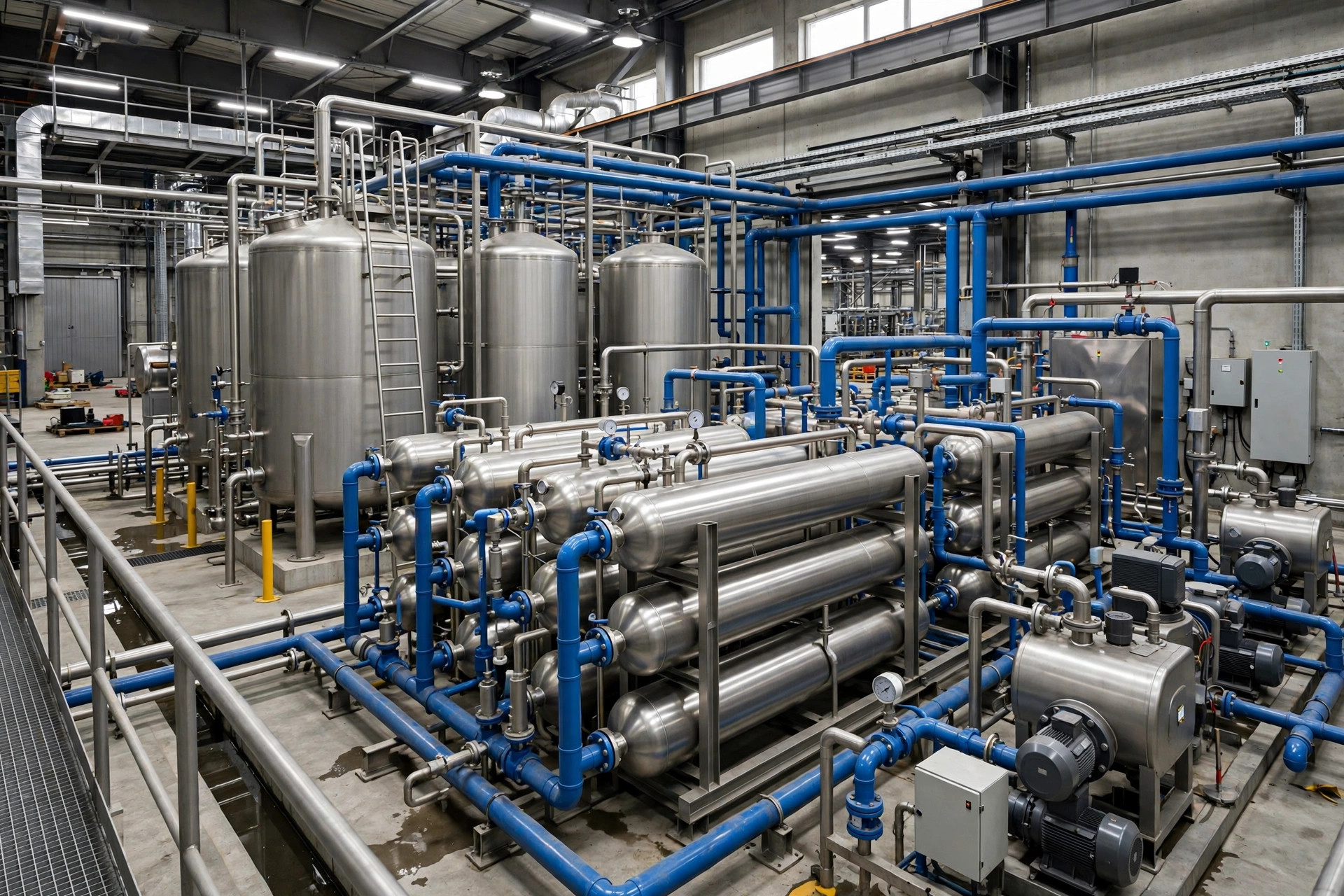
A commercial plant is a small water factory: multi-grade sand and carbon filters, a softener or antiscalant dosing unit, high-pressure pumps, several membrane vessels running in parallel, and a control panel running it all. Home purifiers run a few hours a day; plants run shifts. Feed water is often borewell water with high hardness — exactly what fouls membranes fastest in Gujarat. And the cost of failure is measured in halted production, not inconvenience.
Daily Checks — Five Minutes by Your Operator
Your plant operator (or a trained staff member) should log these every running day:
- Inlet and membrane pressure gauge readings — compare against the plant's baseline, not just "looks okay."
- Permeate (product water) TDS — the single most important number on the plant.
- Reject water flow — water must be flowing to drain during operation; no reject flow means trouble.
- Pump sound and vibration — new rattling or grinding is an early warning.
- Control panel and pipework — no alarm lights, no tripped overloads, no visible leaks around vessels and joints.
Write every reading in a logbook. Memory is not a monitoring system.
Weekly Tasks
- Inspect and clean pre-filters — backwash the multi-grade filter if the pressure drop across it has risen.
- Check dosing chemical tank levels (antiscalant, chlorine) and confirm the dosing pump is running — an empty antiscalant tank silently accelerates membrane scaling.
- Inspect storage tanks for hygiene — lids closed, no algae, no sediment build-up.
- Walk the pipework — joints, valves, and pump seals for drips and seepage.
Monthly and Quarterly Professional Checks
Trend your logbook numbers. A slow rise in permeate TDS or operating pressure is membrane ageing or fouling announcing itself months in advance. Calculate salt rejection — (1 − permeate TDS ÷ feed TDS) × 100 — and watch it, not just the raw TDS figure.
- Softener resin regeneration schedule — verify it actually happens if your feed water is hard.
- UV lamp working hours, if fitted — lamps weaken long before they burn out.
- Electrical panel — contactors, overload relays, earthing; heat and dust kill panels in Gujarat summers.
- CIP (clean-in-place) chemical cleaning when normalized performance drops — a professional job that can restore a fouled membrane instead of replacing it.
What Breaks Most Often in Gujarat Plants
From our service experience across Gujarat, the repeat offenders are: membrane fouling and scaling from hard borewell water (permeate TDS climbs, output drops); high-pressure pump seal wear (noise, falling pressure); solenoid valves and pressure switches sticking (the plant won't start or won't stop); and dosing pump failures that let scaling run unchecked. Almost every one of these shows up in the logbook weeks before it becomes a breakdown — which is why the daily five minutes matter more than any single repair.
Commercial RO Plant AMC in Gujarat
A plant AMC is different from a home purifier AMC: quarterly professional visits at minimum, priority breakdown response, and spare parts billed at pre-agreed rates. Quotes are based on plant capacity (litres per hour), feed-water quality, and running hours — there is no one-size price, so be wary of anyone who quotes without seeing the plant.
Plants on borewell water need closer membrane attention than plants on municipal supply — say so upfront when discussing an AMC, and get the visit schedule and the response-time promise in writing. Nyasa Enterprise services commercial and industrial RO plants across all of Gujarat: plant service visits from ₹1,500, emergency visits ₹2,000, and AMC quotes after we assess your plant's capacity and water source. See our industrial RO plant service coverage for the cities we serve.
Call a Professional Immediately When…
- Permeate TDS jumps suddenly — possible membrane rupture or seal failure.
- The high-pressure pump runs dry or grinds — switch it off and call; running dry destroys pumps fast.
- The plant runs continuously without filling the tank — stuck float valve or pressure switch.
- Burning smell or smoke from the control panel — switch off at the mains first.
- Product water tastes salty or metallic again — the plant is no longer doing its job.
Maintenance Is Cheaper Than Downtime
One avoided shutdown — one production day saved, one hotel's water supply uninterrupted — pays for a year of disciplined checks. The plants that run for a decade are not the expensive ones; they are the maintained ones. If your plant has no logbook, start one today. If it has no service schedule, call +91 63560 23655 and we will set one up — plant service across Gujarat, with the visit schedule and rates in writing before we start.