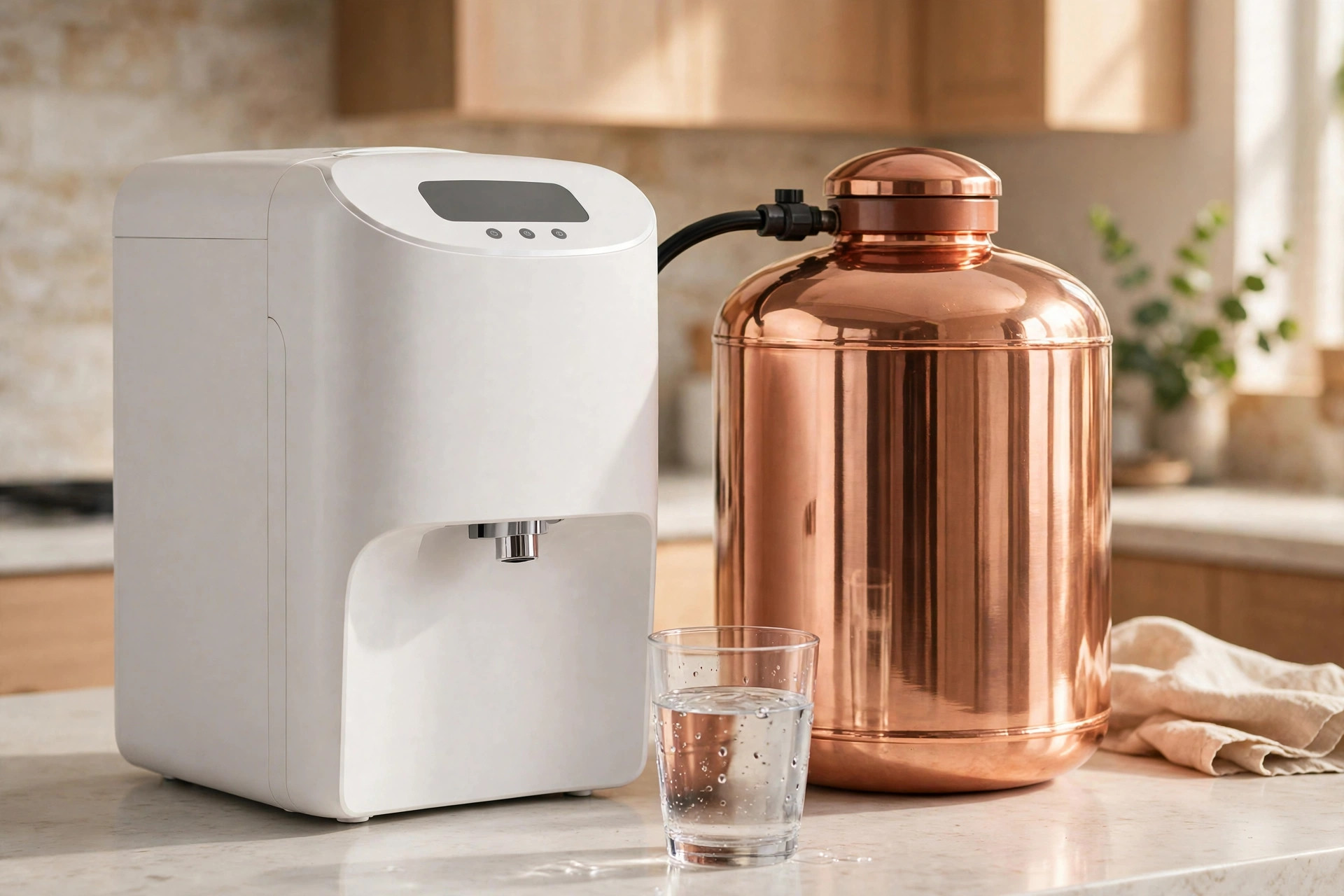
Every major purifier brand now sells a copper RO water purifier — "ancient Ayurvedic wisdom meets modern filtration", they say. The ads show gleaming copper tanks and talk about immunity, digestion and natural purification. But what does the copper stage in your purifier actually do? As an independent service company that opens these machines every day, here is the honest version: some of the marketing is real science, some of it quietly skips over inconvenient details, and none of it is a substitute for the RO membrane doing the real work.
What Copper Genuinely Does
Copper does have a real antimicrobial property — scientists call it the oligodynamic effect. Copper ions can damage the cell walls and genetic material of certain bacteria on contact. This is exactly why Indian households have stored drinking water in copper vessels for centuries, and why the effect holds up in laboratory studies. So the marketing's core claim — "copper is naturally antimicrobial" — is not invented. It is genuine, peer-reviewed science. The catch is in the next section: the fine print about time.
The Contact-Time Catch Nobody Mentions
Here is what the ads skip: copper's antimicrobial effect needs hours of contact to work. Traditional copper vessels work because water sits in them overnight — 8 to 16+ hours. Inside a purifier, water rushes through the copper filter stage in a few seconds on its way to your glass. A few seconds of contact cannot replicate what a full night in a copper pot does. In a purifier, copper is really a mineral enrichment stage, not a purification stage: it adds trace copper to already-purified water. Useful? Possibly. A replacement for filtration? Absolutely not.
What Copper Cannot Do (That the RO Membrane Can)
This is the most important distinction in this article. A copper stage cannot remove dissolved solids (TDS), cannot remove heavy metals like lead or arsenic, cannot remove pesticides, and cannot remove chemical contaminants or sediment. Every one of those jobs in a "copper RO" purifier is done by the RO membrane and the pre-filters — exactly the same as in a non-copper RO. So if your Ahmedabad water is 800+ ppm TDS, the copper branding contributes nothing to making it safe; the RO membrane does 100% of that job. Judge the purifier by its RO stage first, its copper stage second.
Copper Tank vs Copper Filter Cartridge
Brands implement the copper stage in two ways. A dedicated copper storage tank holds the purified water in contact with copper for longer, so it infuses more copper — closer to the traditional vessel idea. But tanks need regular cleaning: an uncleaned copper surface corrodes, develops greenish oxidation (patina), and can leach excessive copper into the water. A copper filter cartridge, on the other hand, is cheaper, needs zero cleaning, and is simply replaced every 6–12 months. Its copper infusion is smaller but more consistent. For most buyers, the cartridge is the practical, low-maintenance choice.
The Costs and Upkeep Nobody Puts on the Box
Copper stages are consumables, just like every other filter. Replacement copper filter cartridges typically cost around ₹800–2,000 per year depending on brand. Copper tanks don't get "replaced" — but they must be cleaned regularly, and a neglected tank with heavy corrosion should be professionally inspected, because that's when copper levels can exceed the safe limit. When we service copper-RO purifiers in Ahmedabad, a quick tank-cleaning is part of a proper service visit — ask your technician to check it, not just the filters.
The Safety Question, Answered Honestly
Copper is an essential mineral your body needs in small amounts, and trace copper in water is not a health hazard for healthy adults. The World Health Organization sets 2 mg/L as the safe limit for copper in drinking water, and purifier copper stages operate well below that when maintained. The risk only appears with excessive long-term intake — for example, water stored for very long periods in a corroded, uncleaned copper tank. We make no disease-curing claims here and neither should any ad: copper water is not a medicine. It's a modest mineral addition to already-clean water.
How to Maintain a Copper RO Purifier
Copper stages only stay useful if they are maintained. If your purifier has a copper tank, have it cleaned at every service visit so corrosion and patina don't build up — a corroded tank can leach excessive copper and also gives the water an unpleasant metallic taste. Copper filter cartridges need no cleaning at all, but they do expire: replace them on schedule, typically every 6–12 months, even if the water "tastes fine". And if your purifier also has an alkaline or mineral cartridge, don't assume they do the same job — they adjust pH and add different minerals, while copper adds only copper. Your technician can check and clean the copper stage during a regular ₹299 service visit.
The Bottom Line
A copper RO water purifier is a good RO purifier with a modest copper add-on. The antimicrobial science is real, the contact-time limitation is real, and the RO membrane still does all the heavy lifting. If you like the idea of copper-infused water and are willing to maintain the tank or replace the cartridge, it is a fine choice. Just don't pay a big premium expecting copper to purify anything — and don't let anyone tell you the copper stage means you can skip the RO membrane. It can't, and it doesn't.