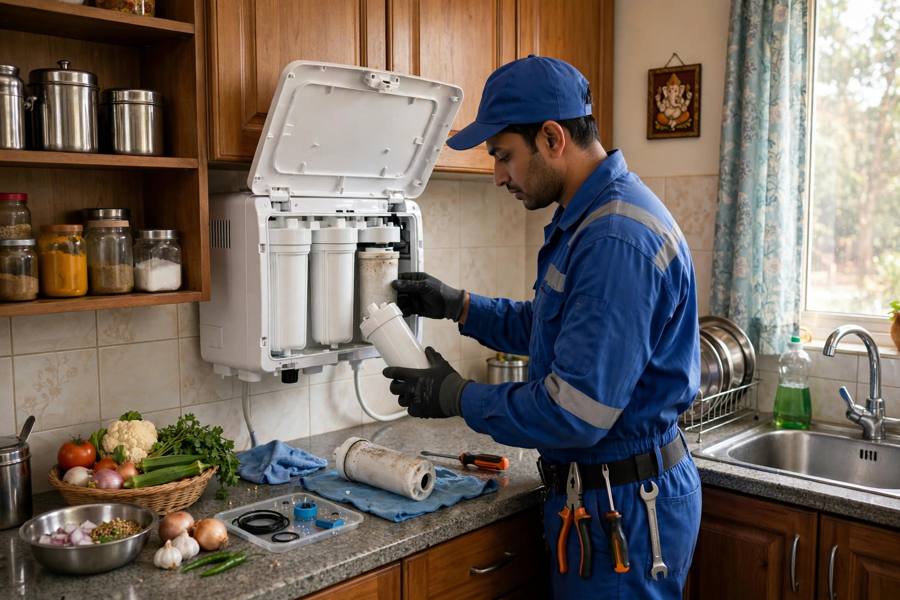
Every RO water purifier develops problems sooner or later — it is a machine that works hard every single day. The good news: most RO complaints fall into just a handful of patterns, and a trained technician can diagnose and fix them in a single visit. Here are the 7 most common RO problems we see in Ahmedabad homes, what causes each one, and how it is professionally fixed.
Why RO Problems Are More Common in Ahmedabad
Ahmedabad is tougher on RO purifiers than most Indian cities. Large pockets of the city — especially areas on borewell supply such as Bopal, Shela, Gota and parts of the west — see TDS levels of 800 to 1,500+ ppm, often with heavy sediment. High TDS makes the membrane work harder and scale faster; high sediment chokes pre-filters in weeks instead of months. Add voltage fluctuations in some localities, and pumps and power adapters take extra strain too. That is why the generic "service once a year" advice in the manual is often not enough here — a 6-month service cycle plus an external pre-filter are the two simplest adaptations for Ahmedabad water.
1. Very slow water flow
Symptoms: The storage tank takes hours to fill, or the tap drips instead of flowing.
Likely cause: A clogged RO membrane or choked pre-filters — the number-one reason for slow flow, especially in high-TDS and borewell water areas.
Professional fix: The technician checks inlet pressure first, then inspects each filter stage. Clogged pre-filters are replaced; a scaled membrane is descaled if salvageable or replaced. DIY-safe? No — opening filter housings without the right technique can crack them.
2. Bad taste or foul smell in water
Symptoms: Water tastes bitter, salty or smells odd.
Likely cause: An exhausted carbon filter (taste/odour) or a worn-out RO membrane (salty taste means dissolved salts are passing through).
Professional fix: Carbon filter replacement for taste issues; membrane replacement plus a TDS check for salty water. The output TDS is re-set to the 100–300 ppm sweet spot. DIY-safe? No.
3. Purifier making loud or strange noises
Symptoms: Grinding, vibrating or humming louder than usual.
Likely cause: A ageing booster pump, loose mounting, or air trapped in the system. Sometimes it is simply the pump straining against clogged filters.
Professional fix: The technician tightens mountings, bleeds trapped air, and tests pump pressure. If the pump is failing, it is replaced with a genuine spare. DIY-safe? Only the mounting check — never open the pump.
4. Water leaking from the unit or pipes
Symptoms: Puddles under the purifier or dripping joints.
Likely cause: Loose pipe connectors, cracked filter housings, or worn O-rings.
Professional fix: Every joint is inspected and re-seated; damaged housings or O-rings are replaced. The unit is run for 15–20 minutes after repair to confirm zero drips. DIY-safe? You can switch the unit off and close the inlet tap immediately — then call a technician.
5. Purifier not switching on at all
Symptoms: No lights, no sound — completely dead.
Likely cause: Power supply issues: a tripped adapter, faulty SMPS, loose wiring, or a dead socket.
Professional fix: The technician tests the socket, adapter output voltage and internal wiring in sequence, replacing only the failed component. DIY-safe? Check the socket with another appliance — but do not open the electrical section yourself.
6. Continuous water wastage — drain never stops
Symptoms: Reject water keeps flowing to the drain even when the tank is full.
Likely cause: A failed auto cut-off valve, a stuck float valve, or a damaged flow restrictor.
Professional fix: The faulty valve is identified by testing each stage and replaced. This single fix can save hundreds of litres of water a month. DIY-safe? No.
7. Filters clogging too fast
Symptoms: You are replacing pre-filters every month or two instead of every 3–4 months.
Likely cause: Very high sediment in your water (common with borewell and tanker supply), or no external pre-filter installed.
Professional fix: Fitting an external sediment pre-filter before the purifier — a small, cheap addition that can double the life of your internal filters. DIY-safe? The external pre-filter is a simple add-on a technician fits in minutes.
When to DIY vs When to Call a Technician
Safe to do yourself: switching the unit off during a leak, checking the power socket, wiping the exterior, and noting down exactly what the purifier is doing wrong (this description helps the technician diagnose faster). Everything involving opening filter housings, electrical parts, the pump or the membrane belongs to a trained technician — one wrong move can crack a housing, void the warranty, or contaminate your drinking water.
How Much Does Each Repair Typically Cost?
Most of the 7 problems above are resolved within a standard service visit: our ₹150 visit charge plus the ₹299 general service covers diagnosis, cleaning and minor fixes. Part replacements are quoted upfront — pre-filters start at ₹199, while carbon filters, valves and pumps cost more depending on your purifier's brand. A membrane replacement is the biggest single expense, which is exactly why catching slow flow early (a cheap pre-filter change) beats ignoring it until the membrane dies. The most expensive repair is always the one delayed too long.
Most of these 7 problems are resolved in a single same-day visit. The key is not to ignore early warning signs: a slightly slow flow today becomes a dead membrane next month. When in doubt, get it checked — a ₹150 visit is the cheapest insurance your purifier can get.