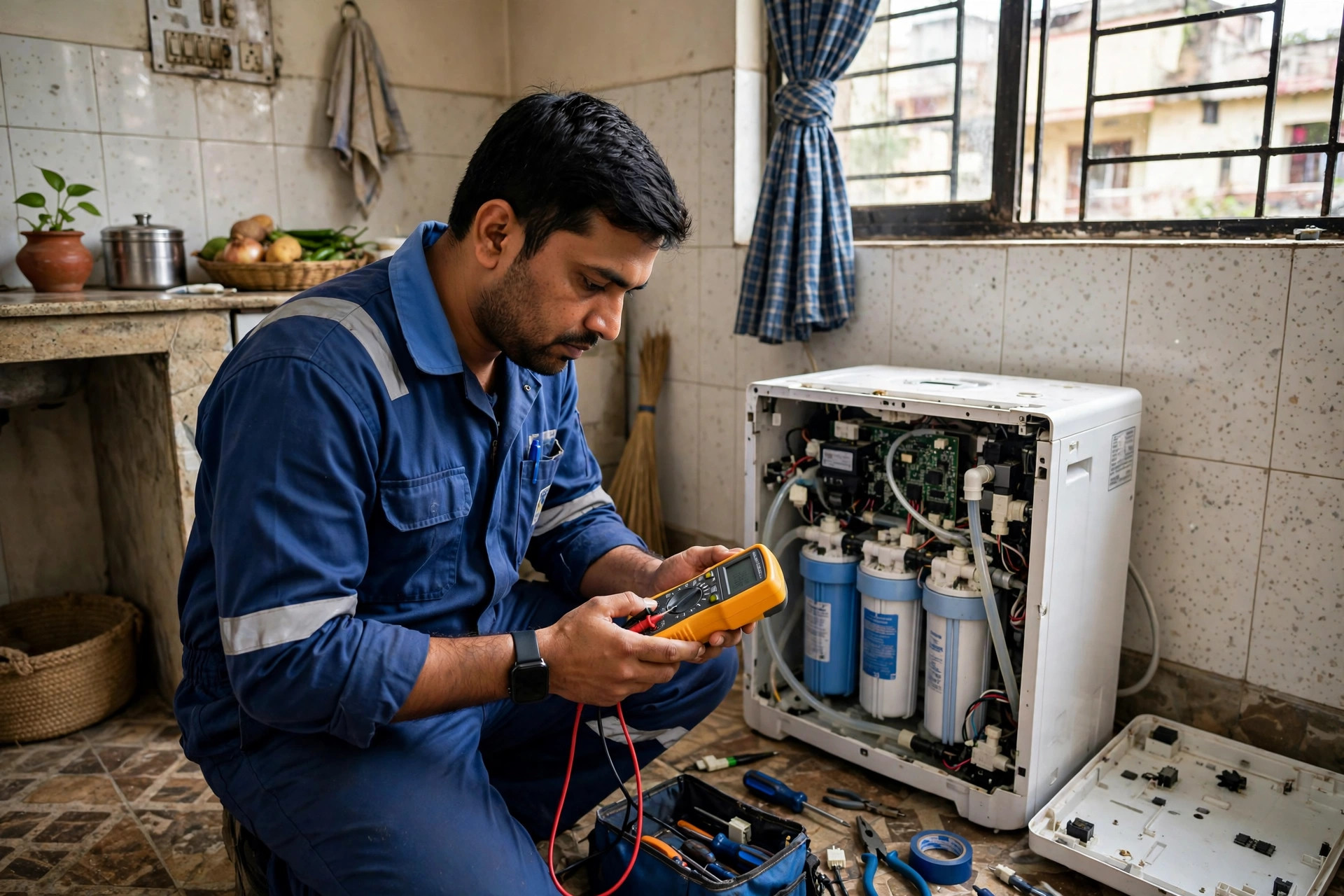
Your RO purifier suddenly sounds like a grinder, or the tank takes hours to fill? Nine times out of ten, the culprit is the booster pump — the small motor inside your purifier that pushes water through the RO membrane. This guide to RO booster pump repair in Ahmedabad explains what the pump does, the warning signs of failure, what an honest technician actually checks before replacing it, and what the repair should fairly cost you in 2026.
What Does the Booster Pump (RO Motor) Actually Do?
Municipal and borewell water in Ahmedabad arrives at low pressure — around 15–40 psi. But an RO membrane needs 60–90 psi to force water molecules through its microscopic pores and reject dissolved salts. The booster pump (also called the RO motor) bridges that gap: it lifts incoming water pressure so the membrane can do its job.
Because it runs every single time your purifier fills the tank, the pump is one of the hardest-working parts inside your RO — which is exactly why it fails more often than most owners expect. In Ahmedabad's hard-water homes, a typical booster pump lasts 2–4 years. Pumps that die earlier almost always have a backstory: clogged pre-filters forcing the motor to strain, or the purifier left running with no water supply.
7 Warning Signs Your RO Booster Pump Is Failing
Learn these signs and you will catch pump trouble before it damages the membrane — a membrane costs more than most pumps.
- Loud humming, buzzing or grinding. A healthy pump hums softly. Grinding, rattling or an unusually loud buzz is the classic "pump dying" sound.
- Very slow water output. If the tank takes 2–3 hours to fill instead of the usual 20–40 minutes, the pump may not be generating enough pressure.
- Pump runs continuously and never cuts off. The auto cut-off switch stops the pump when the tank is full. If the pump keeps running for hours, it cannot build enough pressure to trip the switch — a strong pump-failure signal.
- No water at all, but the pump vibrates. The motor is running but producing no pressure — the pump head or diaphragm may be gone.
- Pump does not start at all. Could be the pump itself, but could also be the SMPS (power adapter) or wiring — a technician tests this before condemning the pump.
- Water tastes salty or TDS reads high. A weak pump cannot push water through the membrane properly, so salt rejection drops and TDS creeps up.
- Pump body feels very hot or smells of burning. Switch the purifier off immediately and call a technician — a burnt motor winding is a fire-adjacent risk you should not ignore.
What an Honest Technician Checks Before Replacing Your Pump
A common trick in this trade is replacing the pump first and asking questions later. A proper diagnosis follows this order — ask any technician to show you the readings at each step:
- 1. Power supply (SMPS/adapter). A dead or weak adapter mimics pump failure perfectly. The technician measures output voltage — 24V systems are standard — before touching the pump.
- 2. Inlet water flow. If the pre-filters are clogged, the pump starves for water and overheats. Filters are cheap; pumps are not. This gets checked second.
- 3. Pressure gauge test. A proper technician connects a pressure gauge at the pump outlet. Below ~60 psi under load means the pump is genuinely weak.
- 4. Solenoid valve (SV). A stuck solenoid blocks water flow into the pump. It costs far less than a pump and fails often enough that it must be ruled out.
- 5. Auto cut-off switch. If the switch is faulty, the pump runs non-stop and looks "failed" when it is actually fine.
- 6. The pump itself. Only after the five checks above come back clean is a pump replacement justified. The technician should also check whether the pump is a standard 24V diaphragm pump so the replacement matches your model.
RO Booster Pump Repair Cost in Ahmedabad (2026)
Our diagnosis visit is a fixed ₹150 — the technician identifies the real fault and quotes the repair before any work begins. For the pump itself, here is what the Indian market looks like:
| Situation | Typical cost | Notes |
|---|---|---|
| Diagnosis visit (fault-finding only) | ₹150 | Our fixed visit charge; adjusted if you take the repair |
| Minor pump repair (bearings, wiring, seals) | Quoted on visit | Possible when the motor winding is intact |
| Booster pump replacement | ₹1,200–₹2,800 | India market range; depends on pump specs and brand compatibility |
| SMPS / adapter replacement (often the real fault) | Quoted on visit | Always tested first — never replaced blindly |
The replacement range above reflects what pump replacements actually cost across India in 2026 — we show it so you can spot inflated quotes. With us, the exact part price is confirmed before the technician fits it, and every part comes with a bill and our 30-day service warranty.
Repair or Replace? The Honest Call
Not every pump problem needs a new pump. Worn bearings, loose terminals, a choked inlet strainer, or a dying adapter can all be fixed at a fraction of replacement cost. But when the motor winding has burnt out (that hot, smoky smell), or the pump head is cracked and leaking, repair becomes false economy — a patched winding rarely lasts a year and can damage the membrane by delivering unstable pressure. A technician who shows you the pressure reading and explains why the pump cannot be saved is being honest; one who simply says "pump kharab, change karna padega" without a single test is not.
How to Make Your Booster Pump Last Longer
- Change pre-filters on time. A clogged sediment filter makes the pump work twice as hard — the single biggest pump killer we see.
- Never run the purifier with the inlet tap closed. Dry-running overheats the pump head in minutes.
- Get the annual ₹299 service. Our ₹299 general service includes a pump-pressure and auto cut-off test that catches weak pumps early.
- Fix small leaks fast. A dripping joint makes the pump cycle on and off all day, wearing it out far sooner.
The bottom line: if you searched "ro booster pump repair near me" or "ro motor repair near me" in Ahmedabad — the ₹150 visit gets you an honest diagnosis, not a sales pitch. The pump is only one of six possible faults, and a technician who tests all six before quoting has earned your trust.