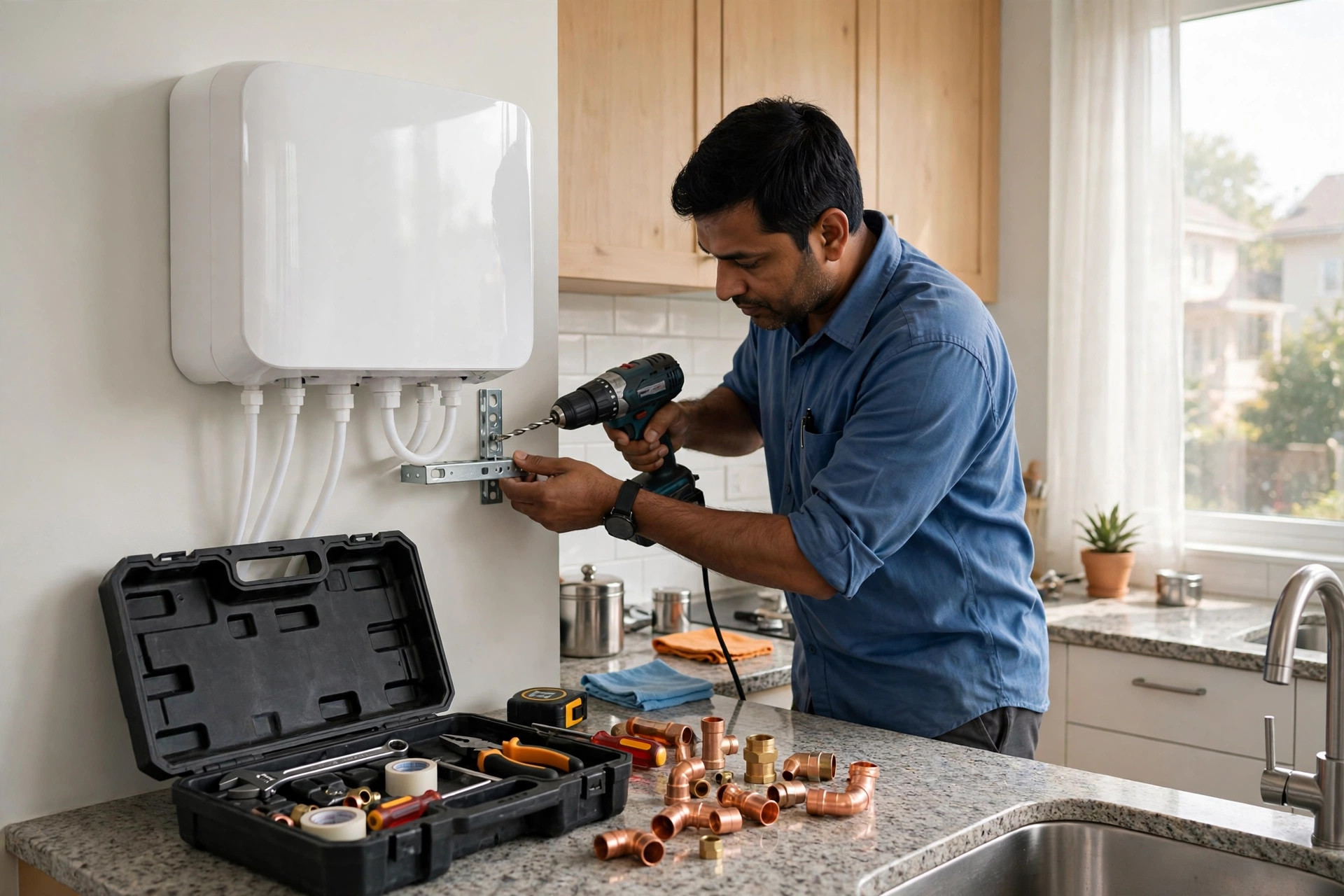
You just bought a brand-new RO purifier — congratulations. But here is the part most buyers learn too late: how it gets installed decides how long it lasts. The RO installation mistakes below are the ones we keep seeing on service calls in Ahmedabad — and several of them can void your warranty, because major brands' warranty cards explicitly exclude improper installation, unauthorized repairs, abnormal voltage and non-approved parts. The fix is simple: a professional installation costs ₹499 and protects a ₹10,000+ purifier.
1. Letting an Unauthorized Technician Install a New Purifier
This is the single most expensive mistake on the list. Most brands' warranty terms say the warranty is null and void if the product is installed, repaired or serviced by anyone other than the brand's authorized dealer or service associate. That means the "cheap" ₹200 fitting by a neighbourhood electrician can silently cancel your 1-year warranty on day one. If anything fails later — pump, membrane, electronics — the brand can point at the unauthorized installation and refuse the claim. Always check who is doing the first installation, and keep the invoice and warranty card safe.
2. Skipping the External Pre-Filter
Ahmedabad's water carries a lot of suspended sediment, especially in high-TDS and borewell-fed areas. An external pre-filter (usually a sediment filter housing outside the purifier) catches this mud and rust before it reaches the purifier's internal filters. Skipping it means the internal sediment and carbon filters clog in weeks instead of months, the membrane gets fouled faster, and your filter-replacement bill doubles. A professional installation always includes checking whether a pre-filter is needed — it is one of the cheapest parts of the setup and one of the most skipped.
3. Ignoring Inlet Water Pressure
RO purifiers are designed for a working pressure band — roughly 10 to 40 PSI for most domestic models. Too little pressure and the booster pump runs dry, overheats and burns out early. Too much pressure and you get leaking joints, a ruptured membrane housing and wasted water. Many Ahmedabad homes have tank heights and plumbing that produce either extreme. A proper installer measures the inlet pressure with a gauge during the visit and fits a pressure-reducing valve (for high pressure) or a booster pump arrangement (for low pressure) when needed. Installations that skip this measurement are guesswork.
4. Routing the Drain Line Wrongly
An RO purifier continuously rejects wastewater, and that drain line has to be routed correctly. The common blunders: running it above the purifier's outlet level so wastewater backs up, leaving it loose in the sink so it splashes and creates a hygiene mess, or sharing it with a contaminated drain where backflow can travel back into the purifier. Any of these can let rejected water — the concentrated impurities your purifier removed — creep back toward the clean side. The drain line should slope downward from the unit, be securely clamped, and terminate in a proper drain.
5. Unsafe Electrical Hookups
RO purifiers need a stable power supply within their rated voltage band (typically 100–300 V at 50 Hz). Installations powered through a loose extension board, a non-earthed socket, or shared with heavy appliances like geysers invite trouble: voltage spikes that fry the adapter or SMPS, and even shock hazards around water. Warranty cards also exclude failures caused by abnormal voltage supply. A professional installation uses a proper wall socket with earthing, positioned away from water splash zones — not a stretched extension cord across the kitchen.
6. Mounting It in the Wrong Location
Location is a bigger deal than most people think. Direct sunlight heats the unit and encourages algae growth inside the storage tank. Mounting above or next to the gas stove exposes it to heat, grease and smoke. Damp, dark corners invite cockroaches and rats — and damage from pests is not covered under warranty. The right spot is shaded, ventilated, away from heat sources, and easy to reach for future servicing. A technician should also leave enough clearance to open the unit for filter changes without pulling it off the wall.
7. Drinking the First Tank Without Flushing
New membranes are shipped with a food-safe preservative coating, and new carbon filters shed fine carbon dust. If you drink the very first tank of water, you are tasting that. A professional installation always runs a full flush — discarding the first one or two full tanks — and then tests the output with a TDS meter in front of you. That TDS reading is your proof the purifier is actually working before the technician leaves. If your "installation" was over in 20 minutes with no flushing and no meter reading, it was not finished.
What a Proper ₹499 Installation Covers
Here is exactly what professional installation at Nyasa Enterprise includes, so you can compare any quote against it:
| Included | What we do | Why it matters |
|---|---|---|
| Site check | Included in ₹499 | Water source, pressure and mounting location assessed before drilling a single hole |
| Wall mounting | Included in ₹499 | Proper brackets and anchors rated for the unit's weight — no cracked tiles |
| Water + electrical connections | Included in ₹499 | Inlet, outlet and drain plumbed; socket and earthing verified |
| Pre-filter advice | Included in ₹499 | We tell you honestly whether your water needs an external pre-filter |
| First flush + TDS test | Included in ₹499 | First tanks discarded, output TDS tested in front of you |
| Usage demo | Included in ₹499 | How to use, clean and when to call for service — explained, not assumed |
The Bottom Line
A ₹499 professional installation protects a ₹10,000–₹20,000 purifier and keeps its warranty valid. The seven RO installation mistakes above are the difference between a purifier that hums along for years and one that is back on the repair bench within months. If you are searching for "professional RO installation in Ahmedabad" — skip the guesswork, and have it fitted right the first time.