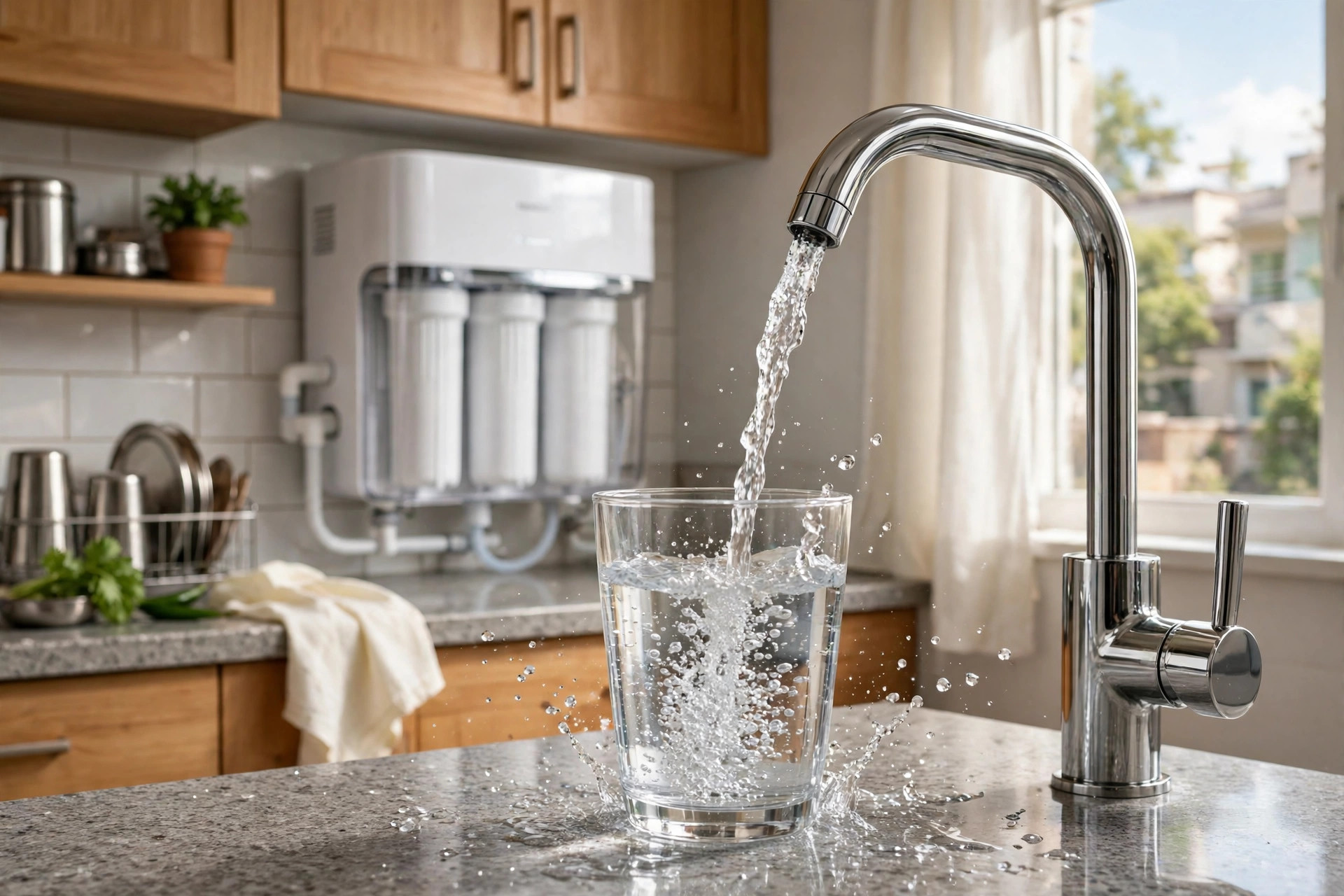
Nothing is more frustrating than turning on the RO tap and getting nothing — or a thin trickle that takes forever to fill a glass. If you are searching for RO repair near me because your purifier has stopped giving water or the flow has dropped sharply, this guide covers what causes both problems, how a technician finds the real fault, and what the repair costs in Ahmedabad and Gandhinagar. The key point first: no water and low flow are not the same fault, and neither one automatically means your membrane is dead. Most cases end with a filter change, a pressure correction or a valve replacement — all far cheaper than a new membrane or a new purifier — provided the diagnosis follows a fixed order instead of guessing.
No Water and Low Flow Are Two Different Problems
Low flow means water still comes out, but slowly: a glass takes minutes to fill, or the tank takes hours to fill up. No water means nothing comes out at all, even though the purifier may be humming, silent, or showing lights. The distinction matters because the likely causes sit in different parts of the machine. Low flow usually points to something partly blocked or weakened — a choked filter, a scaling membrane, a tired pump or a tank that has lost air pressure. No water points more towards something fully closed or dead — no power, no inlet supply, a valve that never opens, or a filter so completely choked that nothing passes. When you call the RO repair contact number, stating which of the two you have already narrows the diagnosis and helps the technician carry the right parts.
Problem, Cause and Solution at a Glance
The table below maps the most common symptoms to their usual causes and the fix a technician applies. It is a guide, not a self-diagnosis certificate — two faults can share one symptom, which is exactly why on-site testing decides the final repair.
| Problem | Usual cause | Typical solution |
|---|---|---|
| No water at all, purifier silent | Dead adapter, blown fuse, loose power connection | Test power supply, replace adapter or fuse |
| No water, purifier humming | Inlet tap closed, blocked inlet, jammed solenoid valve | Restore inlet supply, test and replace valve if jammed |
| Very slow flow from the tap | Choked pre-filter or carbon filter | Inspect and replace clogged filters |
| Tank takes hours to fill | Low tank air pressure, scaling membrane, weak pump | Correct tank pressure, test pump output, TDS-test membrane |
| Flow starts, then stops | Weak pump, tripping low-pressure switch, airlock | Test pump pressure, check switch and bleed air |
| Water flows but TDS stays high | Weak or ruptured membrane, housing seal fault | TDS test across stages, reseat or replace membrane |
The Causes, One by One
Choked pre-filters and carbon filter
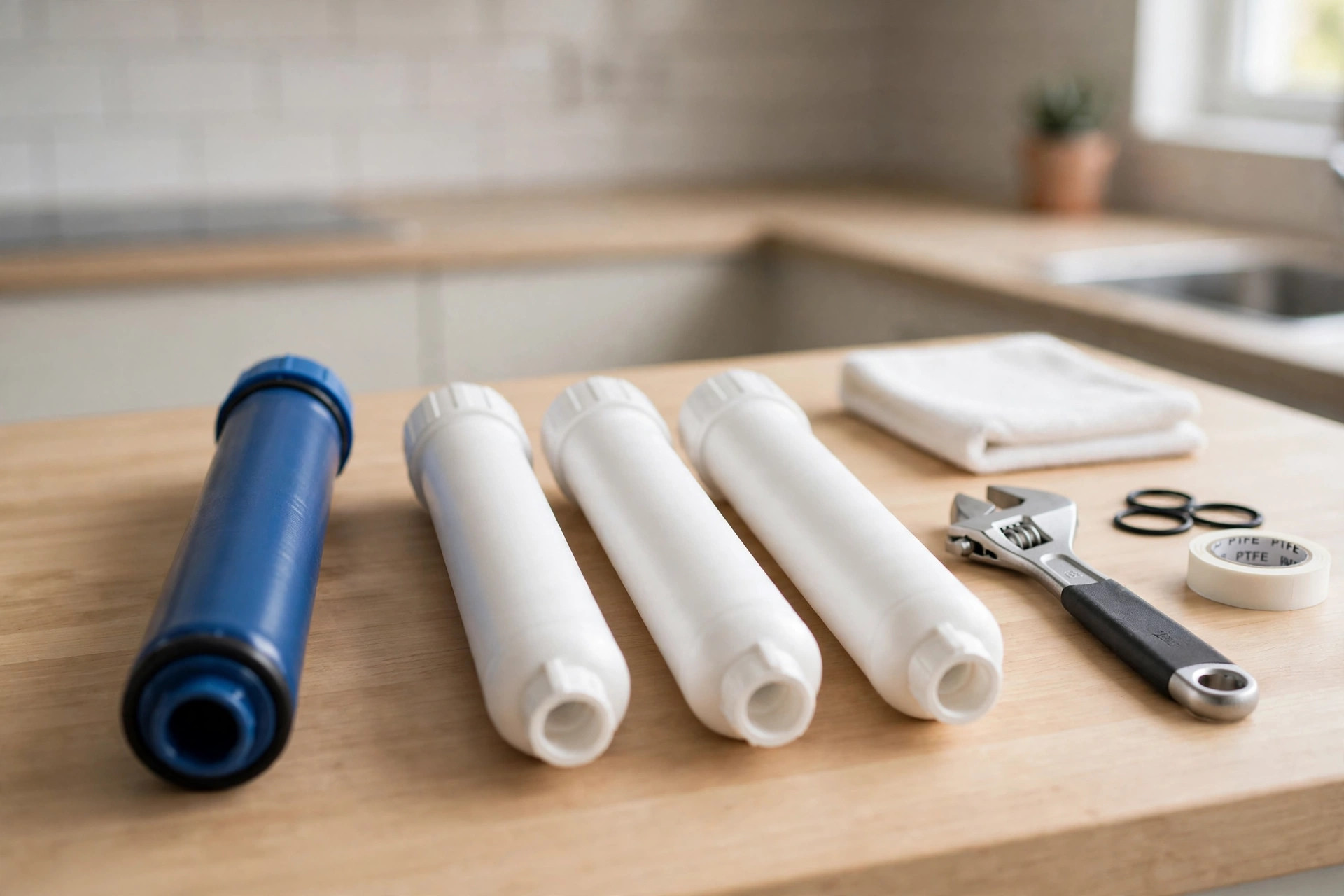
The sediment pre-filter and carbon filter are the first parts water passes through, and they clog fastest — especially in high-TDS and borewell water areas of Ahmedabad. As they choke, flow drops gradually over weeks, which is why many customers only notice the problem when the trickle becomes unbearable. A filter that looks brown and swollen on inspection has done its job and needs replacing, not cleaning. Filters start at ₹199, and a common RO problems visit often ends right here, with no major repair at all.
A scaling or weak membrane
The RO membrane removes dissolved salts, and over time mineral scale coats its surface, slowing output. A membrane does not fail overnight in most cases — flow declines, TDS creeps up, and the tank takes longer to fill. The only honest way to judge a membrane is a TDS meter reading of inlet water versus purified water, taken in front of you. A large drop means the membrane is still working; a small difference means it is weak. Our membrane replacement guide explains the readings in detail. Never accept a membrane replacement that was decided without a TDS test.
Weak booster pump or low pump pressure
RO systems need pressure to push water through the membrane. If the booster pump is weak, runs continuously without building pressure, or cuts off too early, output falls even when the filters and membrane are fine. Pump trouble often announces itself: unusual noise, vibration, or water that starts and stops. The technician tests pump output pressure before quoting any pump work, because a choked filter can mimic pump failure exactly.
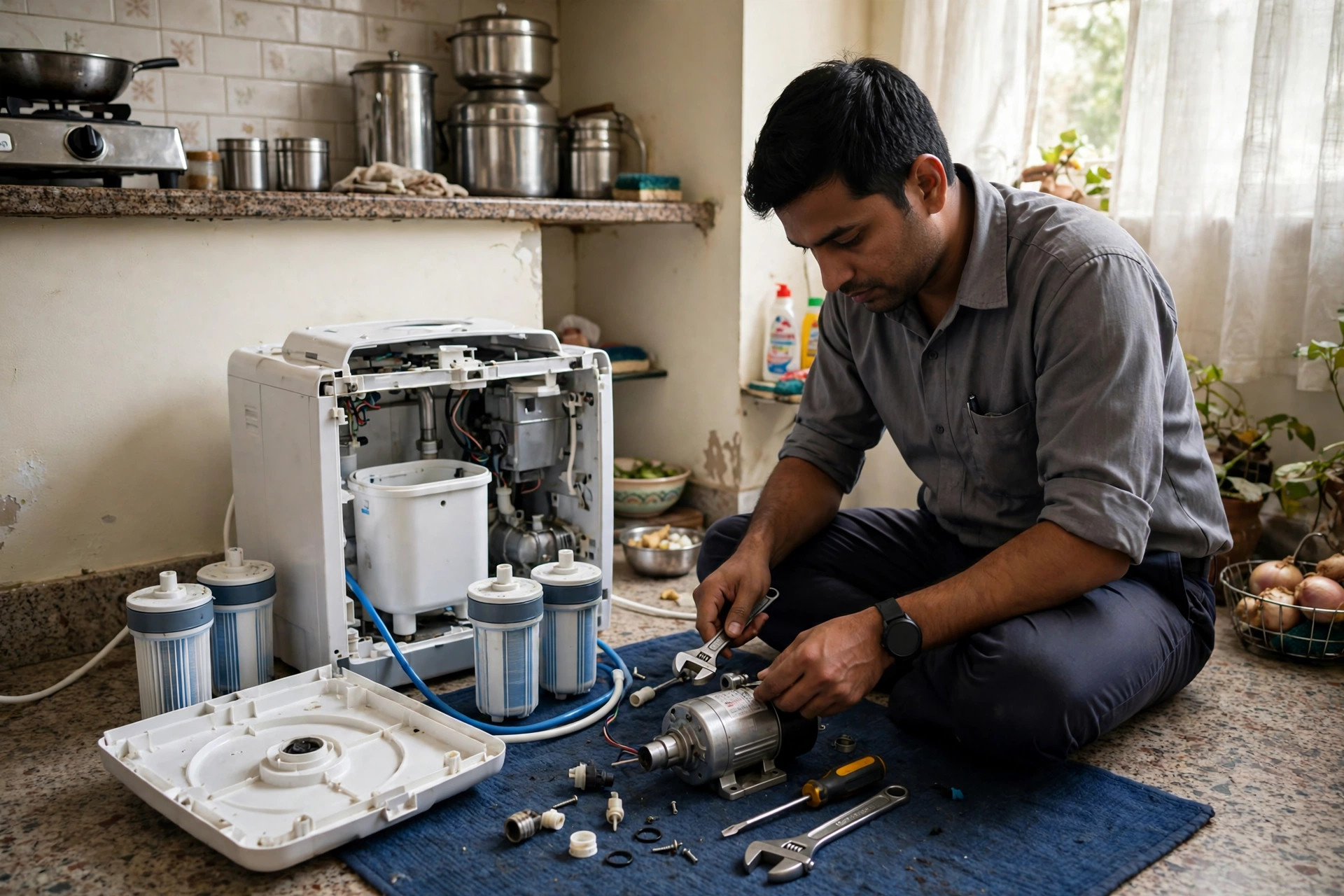
Storage tank pressure loss
The storage tank holds purified water under air pressure, and that pressure is what pushes water out of the tap. When tank air pressure drops, the tank fills slowly or seems never to fill, even though the purifier itself is producing water. This is one of the most misdiagnosed faults: customers are sold a new membrane when all the tank needed was a pressure correction. The diagnosis order exists precisely to catch this — tank pressure is checked before any membrane decision.
Solenoid valve and auto shut-off valve faults
The solenoid valve opens the water inlet when the purifier runs, and the auto shut-off valve stops the system when the tank is full. A solenoid valve jammed shut means no water at all despite a humming purifier; a faulty shut-off valve can make the system behave erratically. Both are small parts, and both are tested electrically before replacement. A RO repair fix guide visit for a "dead" purifier frequently ends with one of these valves.
Low inlet water pressure
Sometimes the purifier is innocent. A weak municipal supply, a half-closed inlet valve, or a choked inlet pipe starves the whole system, and upper-floor homes in Ahmedabad feel this first. The technician checks tap pressure and the inlet valve before opening the machine at all. If inlet pressure is the cause, no spare part is needed — and an honest technician will say so rather than selling one.
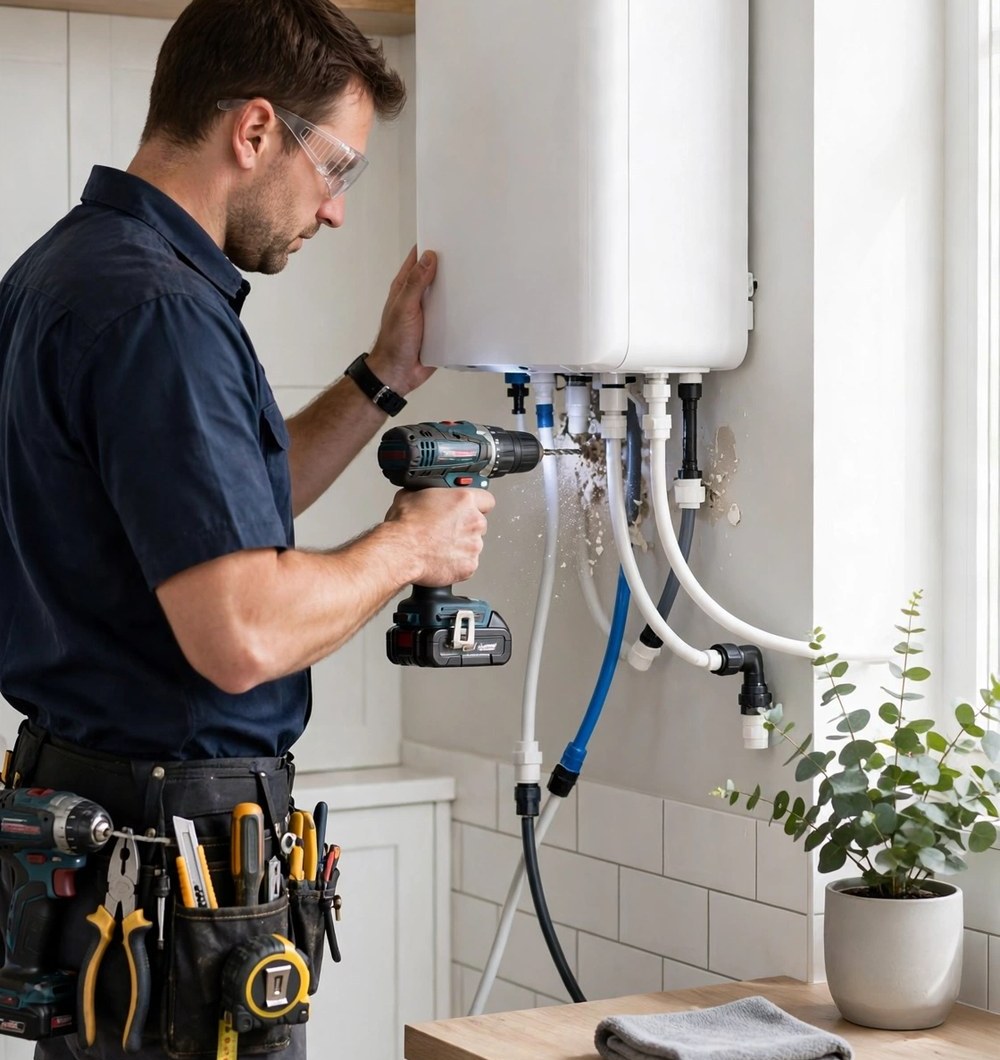
How the Technician Diagnoses It
Diagnosis follows the same fixed order as our full RO repair diagnosis guide: power and adapter first, then inlet pressure, then pre-filters, then membrane and TDS, then pump, then tank pressure, and finally a flow, taste and leak check. The order matters because it tests cheap causes before expensive ones. You can help by being present and asking to see two things: the TDS readings (inlet versus purified) and any old part that is being replaced. A technician who shows you both is giving you a diagnosis you can trust; one who declares the membrane dead in the first two minutes, without a meter in hand, has skipped the process.
What a No-Water or Low-Flow Repair Costs
| Service | Charge |
|---|---|
| Doorstep visit (diagnosis included) | ₹150 |
| Domestic RO service and repair | ₹299 |
| Priority visit (urgent breakdown) | ₹399 |
| Filter replacement | ₹199 onwards |
| AMC plans (scheduled services + breakdown support) | ₹1,999 / ₹2,999 / ₹3,999 per year |
Membrane, pump and valve prices are quoted upfront after diagnosis, because they vary by brand and model — see the RO repair charges guide for the full picture. The comparison that matters: several Ahmedabad repair pages quote a flat ₹399 for repair alone, while here the visit is a fixed ₹150 and the repair starts at ₹299, with parts itemised separately. If you decline the work after diagnosis, you pay only the ₹150 visit charge.
Repair Coverage Across Ahmedabad and Gandhinagar
Doorstep no-water and low-flow repair is available across Ahmedabad — including RO service in Ranip, Chandkheda, Bopal, Gota, Naranpura, Satellite, Sabarmati, Maninagar, Nikol, Naroda, Vastrapur and Thaltej — and across Gandhinagar, including Sargasan, Kudasan, Raysan, Randesan, Infocity, Gift City and all sectors, served from the RO service in Gandhinagar base. Domestic repair service is limited to these two cities, stated plainly so nobody outside them is given a false promise.
When to Call Immediately
Call the same day if the purifier gives no water at all, if water is leaking, if the pump makes a loud grinding noise, or if the water suddenly tastes sharply different. Running a faulty purifier can turn a small repair into a bigger one: a pump straining against a choked filter wears out faster, and a leaking joint damages the wall or cabinet behind the machine. If water is leaking, close the inlet valve and switch the purifier off while the technician is on the way. A priority visit at ₹399 exists for exactly these situations.
Preventing the Next No-Water Day
Most no-water and low-flow breakdowns are preventable. Keep a note of your last filter and membrane change dates — the technician writes them on the job card at every visit. Do not ignore a gradually slowing tap; that slow decline is the early warning, and a filter change at that stage costs far less than a pump or membrane failure later. If your home uses borewell water, expect filters to clog faster and mention the water source at every booking. And once a year, a routine service at ₹299 — cleaning, filter check, TDS test and tank pressure check — catches the faults that otherwise arrive as a sudden no-water morning. If your purifier also leaks, read the companion RO leakage repair guide; leakage and low flow often share the same root causes, and fixing one without checking the other invites a repeat visit.
No Water Right After a Filter Change
A special case deserves its own note: the purifier worked yesterday, the filters were changed today, and now it gives no water at all. This is more common than customers expect, and it rarely means the service damaged the machine. The usual cause is air trapped in the filter housings after they were opened — an airlock that stops water from moving even though the pump is running. A second possibility is a valve left closed at the end of the service, or a housing not seated fully, which breaks the pressure seal. Both are quick corrections: the technician bleeds the trapped air, checks every valve position, and reseats the housings. If no water appears within an hour of a service visit, call the same repair numbers and say the problem started right after the service — the technician will know exactly which checks to repeat, and there is no need to wait days hoping it clears on its own. Carbon fines from a brand-new carbon filter can also slow the first few litres; that settles with flushing and is different from a true no-water fault, which is why the technician distinguishes the two on inspection rather than over the phone.